
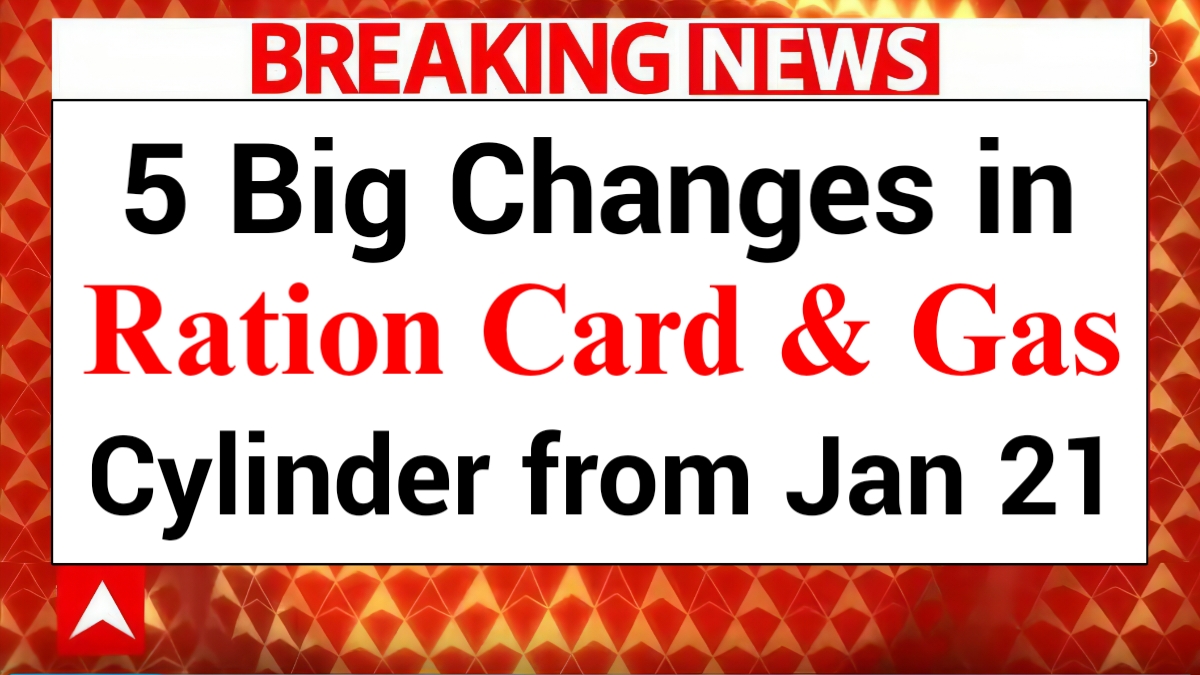
Ration Card & Gas Cylinder Rules 2026: The rollout of the Ration Card & Gas Cylinder Rules 2026 marks one of the most wide-ranging updates to India’s welfare delivery system in recent years. From January 21, households that depend on subsidised food grains and LPG cylinders will operate under a new framework shaped by technology, tighter verification, and expanded eligibility. While reforms to ration cards and cooking gas supplies are not new, the scale and timing of these changes have drawn widespread attention across states.
The background to this shift lies in rising food inflation, the push for cleaner cooking fuel, and the government’s continued reliance on digital systems to plug leakages. Over the last decade, Aadhaar-based transfers and e-KYC checks have steadily replaced paper records. The 2026 rules take that process further, combining food security and fuel access under stricter compliance norms. For families, especially those balancing tight budgets, understanding what has changed is now as important as the benefits themselves.
Expanded Income Limits Reflect Economic Pressures
One of the most closely watched updates under the Ration Card & Gas Cylinder Rules 2026 is the expansion of income limits for eligibility. In several states, the ceiling has been raised to ₹1.2 lakh annually, a move that quietly acknowledges how inflation has eroded purchasing power. Families that were previously classified as “just above the line” now find themselves eligible for subsidised grains, offering some relief from volatile market prices.
Policy analysts note that this change reflects a broader rethink of welfare targeting. “Income thresholds frozen for years stop reflecting reality,” says Ananya Rao, a public policy researcher based in Delhi. Compared to earlier revisions that lagged behind economic conditions, the 2026 adjustment is more responsive. Still, experts caution that implementation will vary by state, and local administrations will play a decisive role in determining who ultimately benefits.

Digital Verification Tightens the Safety Net
Mandatory e-KYC has become the backbone of the new ration card system. From January 21, beneficiaries who fail to complete digital verification risk interruptions in grain supplies or LPG subsidy credits. The government argues that this step is essential to eliminate duplicate and ghost beneficiaries, an issue that has long plagued public distribution networks, particularly in densely populated urban areas.
For many households, the shift brings mixed reactions. Urban residents with smartphones and stable internet see e-KYC as routine. In contrast, rural families worry about access and awareness. State governments have responded by setting up temporary camps and mobile vans to assist with verification. The emphasis on digital identity underscores how welfare delivery is now inseparable from technology-driven governance.

Aadhaar-Linked LPG Subsidies and Extra Refills
LPG distribution rules under the 2026 framework place Aadhaar linking at the centre of subsidy delivery. Subsidy amounts will be credited only to Aadhaar-seeded bank accounts, reinforcing the direct benefit transfer model introduced years ago. Officials say this closes gaps where subsidies were delayed or diverted, ensuring that assistance reaches households without intermediaries.
The promise of two free LPG refills annually for Ujjwala beneficiaries has also generated optimism. For families that still juggle between cylinders and traditional fuels, these refills could reduce dependence on firewood. Compared to earlier schemes offering limited support, the expanded provision signals a renewed focus on health and environmental outcomes, particularly for women who bear the brunt of indoor air pollution.
Food Grain Allocation and the Trust Deficit
Changes in the quantity of rice and wheat supplied through ration cards have sparked debate at the local level. While the government describes the revision as a balance between availability and demand, families are keen to see how it plays out at fair price shops. Past experiences of uneven distribution have made beneficiaries cautious, even as officials promise smoother operations.
Transparency measures embedded in the new rules aim to address this trust deficit. Aadhaar-linked records, digital stock monitoring, and clearer entitlement data are expected to reduce corruption. “When people can track what they are entitled to, confidence improves,” notes Rao. The real test, however, will be consistency across districts, where administrative capacity often determines outcomes.

Urban and Rural Impact as 2026 Approaches
Although rural households remain at the heart of welfare policy, urban families are increasingly affected by rising food and fuel costs. The revised income limits and streamlined verification processes extend benefits to lower-middle-class city residents who were earlier excluded. In metropolitan areas, digital systems are likely to function more smoothly, reducing delays that once characterised subsidy delivery.
Looking ahead, experts expect further integration of welfare databases, possibly linking nutrition, health, and energy schemes. The January 21 rollout is seen as a stepping stone rather than an endpoint. As states adapt to the Ration Card & Gas Cylinder Rules 2026, households that stay informed and compliant will be best positioned to navigate the evolving landscape of India’s social safety net.
Disclaimer: This article is intended for general informational purposes only. Welfare policies, eligibility criteria, and implementation timelines may differ across states and districts. Readers are advised to consult official government notifications or local authorities for the most accurate and updated information regarding ration cards and LPG subsidies.