
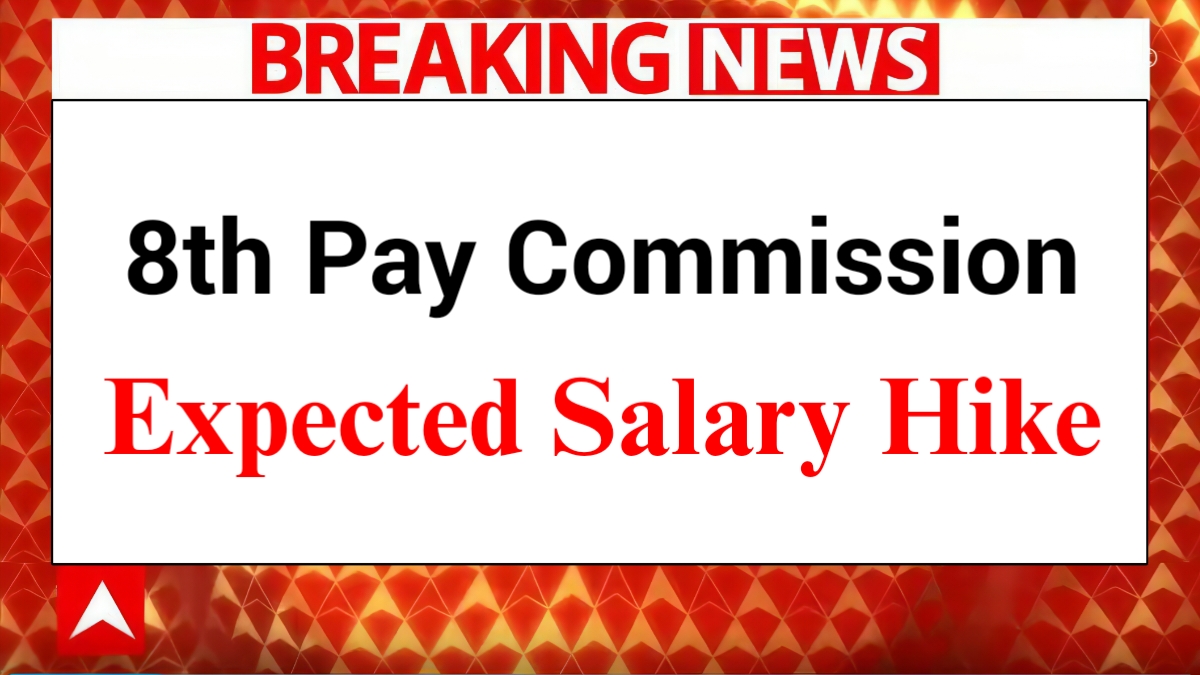
8th Pay Commission 2026: The debate around the 8th Pay Commission has quietly moved from official corridors into everyday conversations among central government employees and pensioners. With 2026 frequently cited as the likely year of implementation, expectations are building even though the government has not yet issued a formal notification. This is not unusual. Historically, pay commissions in India gather momentum years before they are formally constituted, driven largely by inflation trends, fiscal pressures, and employee demands.
The primary reason this discussion matters is simple: a new pay commission does not just tweak salaries. It resets the entire compensation architecture for millions of serving employees and retirees. From basic pay and allowances to pensions and future Dearness Allowance (DA) revisions, the ripple effects last for a decade or more. At the heart of the current speculation lies one number — the fitment factor — which could determine whether 2026 becomes a modest adjustment or a transformational jump in take-home pay.

Why the 8th Pay Commission Is Back in Focus
Pay commissions are typically set up every ten years, and the 7th Central Pay Commission came into effect in September 2016. By that timeline alone, 2026 naturally emerges as the next milestone. What has sharpened attention this time is the prolonged spell of high retail inflation, rising housing and education costs, and a perception among employees that real wages have been steadily eroded despite periodic DA hikes.
Adding to this is the experience of past commissions. The 6th and 7th Pay Commissions were both preceded by years of informal discussions, committee-level deliberations, and union memoranda. Employee federations have already begun flagging concerns, arguing that waiting too long could make the eventual correction more expensive and disruptive. For the government, this creates a delicate timing question: move early and spread the cost, or delay and face steeper expectations.

Understanding the Fitment Factor and Why It Matters
The fitment factor is often mentioned casually, but its implications are anything but small. It is the multiplier applied to an employee’s existing basic pay to arrive at the revised basic under a new pay commission. When the 7th Pay Commission introduced a fitment factor of 2.57, it effectively reset pay scales across levels, forming the base on which DA and allowances are calculated even today.
For the 8th Pay Commission, employee unions are pushing for a higher fitment factor, citing cumulative inflation and lifestyle costs since 2016. Informal discussions in policy circles suggest a possible range between 2.86 and 3.68. To put this in perspective, even a jump from 2.57 to 2.86 would translate into a noticeable rise in monthly income, while a factor closer to 3.5 would represent one of the sharpest pay revisions in decades.

Expected Salary Impact Across Pay Levels
If a higher fitment factor is approved, its impact will not be uniform. Entry-level employees may see a sharper percentage increase, improving starting salaries and helping recruitment competitiveness. Senior officers, on the other hand, would experience a much larger absolute jump, given their already higher basic pay. In both cases, the psychological effect of a reset cannot be understated.
More importantly, basic pay is the foundation for several allowances. House Rent Allowance (HRA), Transport Allowance (TA), and future DA calculations all depend on it. A higher basic pay under the 8th Pay Commission would therefore amplify not just immediate earnings but also long-term income growth. This cascading effect is precisely why the fitment factor becomes the most closely watched number in any pay commission discussion.

What It Could Mean for DA, Pensions, and Retirees
Dearness Allowance has become the government’s primary tool to offset inflation between pay commissions. Once the new basic pay is fixed under the 8th Pay Commission, all future DA increases will be calculated on that enhanced base. This means that even modest DA hikes post-2026 could translate into significantly higher cash payouts compared to the current structure.
Pensioners, too, have a direct stake. Pensions are linked to the last drawn basic pay or revised notional pay, depending on the formula adopted. A higher fitment factor would automatically raise the pension base, offering sustained relief to retirees who depend almost entirely on monthly pension income. As economist R. Mahadevan notes, “For pensioners, the real benefit of a pay commission is not the one-time revision but the long-term protection it offers against inflation.”

The Government’s Fiscal Tightrope Walk
While expectations among employees are high, the government faces a complex fiscal equation. Implementing a generous fitment factor across the board would involve a substantial increase in salary and pension expenditure, with knock-on effects for state finances as well. Past commissions have added significantly to the fiscal deficit in the short term, even if they boosted consumption and tax collections later.
This is why many analysts believe a phased or calibrated implementation cannot be ruled out. The government could choose staggered pay revisions or delay arrears to soften the immediate budgetary shock. Such approaches have precedent, but they often invite criticism from employee bodies. The challenge will be to balance fiscal discipline with the legitimate expectation of fair compensation.
What Employees Should Watch in the Coming Months
For now, the absence of an official notification means all figures remain speculative. However, key signals will emerge once the government announces the constitution of the 8th Pay Commission and its terms of reference. These documents typically reveal the government’s priorities, whether cost containment, structural reform, or outright wage correction.
Employees and pensioners would be wise to track developments carefully rather than rely on headline figures alone. Understanding how revised pay matrices work, how fitment factors translate across levels, and how allowances are recalculated can help individuals form realistic expectations. As history shows, the final outcome is often a negotiated middle ground rather than the most optimistic projection.
Looking Ahead to 2026
The 8th Pay Commission is shaping up to be more than a routine exercise. It arrives at a time when economic conditions are uncertain, inflation has tested household budgets, and public sector employment is under increasing scrutiny. A well-calibrated pay revision could restore confidence and purchasing power, while a misjudged one could strain public finances.
Ultimately, the fitment factor will decide how transformative the 8th Pay Commission turns out to be. Whether it delivers modest relief or a substantial reset, its effects will be felt across salaries, pensions, and government spending for years to come. Until official clarity emerges, cautious optimism remains the prevailing mood.
Disclaimer: This article is based on publicly available discussions, historical trends, and informed speculation around the 8th Pay Commission. No official notification or confirmation has been issued by the Government of India at the time of writing. Figures related to fitment factors, implementation timelines, and salary impact are indicative and subject to change. Readers are advised to rely on official government announcements for final and binding information.