
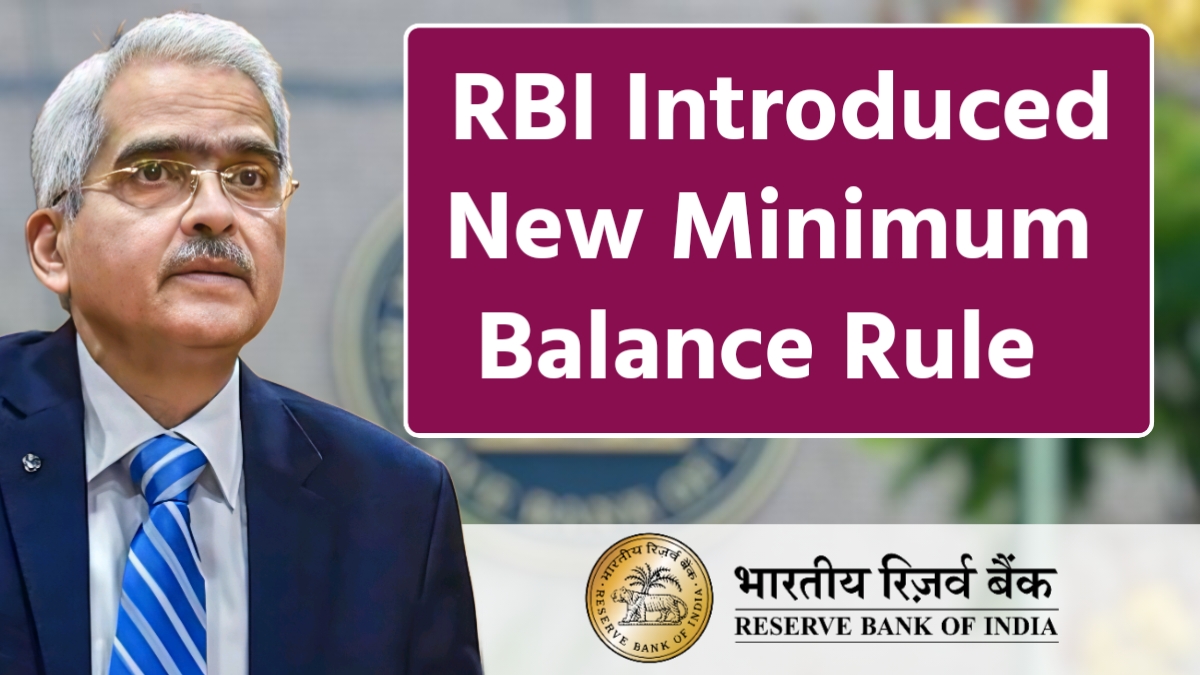
New Minimum Balance Rules: From January 15, 2026, India’s banking system entered a new phase without the noise that usually accompanies regulatory shifts. There were no dramatic announcements or emergency circulars splashed across television screens. Yet, for millions of Indians checking their savings or current account balances, the change is already real. The Reserve Bank of India’s revised framework on minimum balance requirements has come into force, altering the everyday relationship between banks and customers.
The RBI minimum balance rules do not mandate a single uniform figure across banks. Instead, they tighten the rules of engagement how balances are communicated, how penalties are imposed, and how clearly customers are warned. In a financial ecosystem dominated by UPI payments, automatic subscriptions, and app-based spending, account balances now rise and fall far more rapidly than they did a decade ago. The regulator’s intent is to reduce surprise charges and bring accountability into a system where small lapses often led to outsized penalties.

Why the Regulator Chose This Moment
The timing of the RBI’s intervention is closely tied to how banking itself has evolved. Over the last ten years, banks have invested heavily in digital infrastructure—real-time settlement systems, cybersecurity frameworks, fraud monitoring, and compliance technology. These are not one-time expenses but recurring costs that grow as transaction volumes rise. Older minimum balance norms, framed in a largely branch-driven era, no longer reflected the true cost of maintaining active accounts.
There was also concern about the swelling number of dormant and low-balance accounts. Many were opened during government benefit drives or for temporary use and then left untouched. Each account, active or not, still carries regulatory obligations. According to a former public sector bank executive, the revised framework acknowledges this reality. “The RBI is saying that transparency is better than pretending these costs don’t exist,” he notes, pointing out that clarity benefits both banks and customers.

Savings Accounts in Cities Feel the Shift First
For urban savings account holders, the change is subtle but persistent. Most large banks have retained minimum balance thresholds around ₹3,000, but enforcement has become sharper. Digital alerts now arrive quickly when balances dip, and penalties follow sooner than before. In households where multiple streaming services, utility bills, and insurance premiums are auto-debited, balances can fall unexpectedly within days.
The RBI has, however, preserved its inclusion-first stance. Rural branches, basic savings accounts, and Jan Dhan-linked accounts continue to enjoy zero or minimal balance requirements. Banks are also nudging customers towards specialised products student accounts, senior citizen variants, and pension-linked savings options. Chennai-based financial counsellor Suresh Iyer sees this as a behavioural nudge. “People are being asked to treat their savings account as something to manage, not just a passive wallet,” he says.

Current Accounts and the Pressure on Small Businesses
The sharper edge of the new RBI minimum balance rules is being felt by current account holders. Small traders, freelancers, and MSMEs now face clearer thresholds, often ranging from ₹12,000 to ₹30,000 depending on the bank, location, and services bundled with the account. For businesses that operate on tight cash cycles, this effectively locks a portion of working capital inside the banking system.
Banks argue that higher maintained balances support faster settlements, detailed transaction analytics, and priority servicing. Not everyone is convinced. A Bengaluru-based fintech consultant working with small retailers frames it bluntly: “Earlier, the cost of banking was hidden. Now it’s explicit. You either keep money parked or you pay a monthly charge. That forces businesses to reassess how many accounts they really need.”

How This Differs From Earlier Banking Norms
Minimum balance rules in India have long existed, but enforcement was uneven. Customers often discovered penalties weeks later, buried deep in account statements. Rules varied not just between banks but even between branches. The post-Jan Dhan years prioritised access over discipline, encouraging account opening at scale while downplaying maintenance obligations.
The 2026 framework signals a course correction. Banks are now expected to publish thresholds clearly, issue timely digital alerts, and standardise customer communication. This mirrors practices in more mature banking markets, where transparency replaces cross-subsidies and surprise fees. The RBI appears confident that India’s digitally savvy population can handle explicit obligations, provided they are communicated honestly.

Public Reaction, Expert Views, and What Comes Next
Initial public response has been mixed. Some customers welcome clearer rules, arguing that predictable charges are better than sudden deductions. Others worry about balance volatility in a UPI-driven economy. Social media complaints tend to spike when penalties hit without adequate explanation, putting pressure on banks to improve customer education.
Economist and banking analyst Arvind Kulkarni believes the long-term outcome will be healthier. “This isn’t about forcing people to keep idle money,” he says. “It’s about making the cost of banking visible so choices are intentional.” Over time, customers may consolidate accounts or migrate to zero-balance digital options, while banks could benefit from cleaner, more active account bases.
Disclaimer: This article is based on publicly available information and a general understanding of RBI minimum balance rules applicable from January 2026. Minimum balance requirements, penalties, and account features vary by bank, account type, and location. Readers are advised to verify specific details with their respective banks or official communications. The content is intended for informational purposes only and should not be considered financial or legal advice.